
Thursday, April 17, 2014

Saturday, April 5, 2014
Revolutionaries Don’t Typically Find Themselves As Mayor
Remembering Chokwe Lumumba
Can you be a revolutionary and a mayor? Chokwe Lumumba—who
spent eight months as mayor of Jackson, Mississippi, before he died—did
his best to be both.
posted Feb 26, 2014
-
Photo by Natalie Maynor.

A founder of the Malcolm X Grassroots Movement, an activist attorney, and a former City Council member, Lumumba was elected Mayor of Jackson in June 2013 with 86 percent of the vote—despite being massively outspent. In office, he brought people together across class and race lines and thawed a multi-year freeze between the city and state legislators.
His language was direct and his goal was "revolutionary transformation." He not only inspired his own community, but he also disarmed his critics with a tireless commitment to building support for his twin goals of political and economic democracy.
"The mission is to accomplish economic development together," he told me in an interview just two weeks before his sudden death by heart attack. We met in his office in Jackson City Hall on February 12 to talk about "solidarity economics" for an upcoming article for YES! Magazine's Commonomics project.
Here is our full conversation.
Laura Flanders: First off, congratulations on your election.
Chokwe Lumumba: Thank you.
Flanders: What do you want to accomplish?
"I went to law school to defend people who had no one to defend them and causes that nobody would defend."Lumumba: We want to accomplish a revolutionary transformation. We are party to statistics which demonstrate that our people, black people in particular and probably the majority of the Mississippi population, are at the worst end of all the vital statistics. When it comes to the discussion of oppression in America, we’ve been experiencing the worst of it for a long time. What’s exciting to me is the prospect of going from worst to first in a forward-moving transformation which is going to take groups of dispossessed black folks here and others and make us controllers of our own destiny.
We are not foolish enough to think that it is a mission that can probably be accomplished here in the absence of fundamental movement in the rest the world, but we think we can start that movement and help carry it forward, and help advance it in a really powerful way. So that’s what excites us.
Flanders: And your specific goals?
Lumumba: We find ourselves in a situation where we are in the "Kush" district. Kush is an ancient name for an area around Egypt, which in ancient times, encompassed a historically black community which became the genesis of Egypt and Ethiopia and others. We use the terminology to refer to a "black belt," areas which are predominantly black, but there’s a distinct reference to a formation of black counties in Mississippi: Tunica to Wilkinson, all contiguous, 18 counties, 17 of them majority black including Hinds county where Jackson sits, only one majority white, and it teeters on the edge of being majority black.
"Kush," the concept, is larger than Mississippi. It goes across the border into Louisiana and the predominantly black counties of Louisiana and Southeast Arkansas. This is really a broader area than where we are, but we in Mississippi are the center of commerce of that area. We’re 85 percent black. This is an important area because it gives us a chance to demonstrate real vitality, to vindicate that terminology of black power which was used years ago, but was so much in search of definition at the time.
Flanders: What do you mean?
Lumumba: We knew we were getting short-changed in the whole so-called integrationist movement, which in truth was a struggle for democratic rights; in our struggle against Jim Crow, we knew we were coming up short. And so we defined ourselves as being in a struggle for Black Power and became a black liberation movement with various different objectives. One which was central which we set out for ourselves was for us to develop a sense of self-determination for all people in America. And this is a region where that purpose is particularly important and where it can be particularly achieved, or at least get off the starting blocks. That’s the vision.
Flanders: And how does that vision intersect with your mayoralty? What tools do you have in your tool box as mayor to make that sort of change?
Lumumba: We’re still figuring that out. We’re still unpacking. We know it’s not the normal things mayors do. …
Flanders: Which is?
Lumumba: Mayors normally help out the economic powers-that-be and try to make sure they can avoid the issue of crime as much as possible, and point to prosperity by moving and shuffling people around in a gentrifying set of circumstances, by trying to get the poor people out of town and getting rich people in.
We are way different than that and we don’t mind saying it. In fact, we just had an interesting discussion at the city council where one of the councilmen (I like to think partly inspired by my inauguration speech), actually brought up a resolution against gentrification and it was part of a conversation which got us to try to explain the problems with gentrification and why we want to move ahead.
Flanders: Can you be a revolutionary and a mayor?
Lumumba: Mayors typically don’t do the things we’re trying to do. On the other hand, revolutionaries don’t typically find themselves as mayor.
Change does not come on thoughts alone; because we have a revolutionary ideology and give speeches on it. It comes because you can change the material conditions of people, and get people to assist in the change, be the mainstay in the change in their conditions. And so, how do we achieve that, that’s the real challenge for us. We don’t think we can do it in the way we did it in the 60s and 70s. We raised up millions of people in fiery speeches and that was good—I’m in love with that period—but at the same time, the people been suffering for a while and fiery speeches are not going to do it.
We’ve got to tell them how we’re going to fix their streets; how we’re going to feed them, how are they going to eat, where are they going to live. How are they going to avoid being in a neighborhood which goes unattended for so long that it becomes a target for urban renewal which is really just urban removal and then they lose their homes and they turn around and they’ve got condominiums there, and they can’t afford to buy a condo and then they’re shuffled out to the outskirts of the city where once again, they find themselves in another community of poverty, or even in a community of poverty outside the city.
How the kids are going to get a real education as opposed to just showing up to school and being on the pipeline to prison? Those are the material things we’ve got to change. That’s an exploration process. It doesn’t require any less knowledge or commitment to the ideals we started off with, but it requires the ability to translate the message in ways that people can understand and become part of and can teach us. We have to understand the language of the people.
Flanders: Typically mayors cut taxes, grant subsidies to potential employers, create low tax or no tax empowerment zones and woo big-box stores to come to their town. How much of that will you do?
Lumumba: We’re going to be doing some of that. Some of that is involved. We have to create economy. That has to happen. What is revolutionary is that we want to convert this economy into something different at some point. But you have to create economy and what you convert it to is not necessarily what creates it.
And so for instance the idea that we started out this administration on is infrastructure: We have to convert infrastructure into economic growth.
"Even though we’re great revolutionaries, we’re worried about the potholes in our street too."When we talk about economic growth, we’re not talking about bringing a bunch of companies in that can make a bunch of bucks and hope they spend ’em in our city. We’re talking about creating jobs, creating new companies and then we move from there to talk about cooperatives which can become some of those jobs, some of the solidarity economy where we can begin to band together people so they’ll understand that a job is not a single individual affair but a collective affair; the creation of jobs is not an individual affair but a collective. The mission is to accomplish economic development together.
We have to convert and teach that. It is our view that you can accomplish that better by putting people in a position where there is some production coming forth in the economy rather than people [being] worried about survival every day of their lives, for whom it’s difficult to confront anything because they’re fighting just for existence. So what we’re doing is creating movement and economy by that infrastructure thing. And we’ve done things in order to raise revenue, which is going to go into our infrastructure. We’re going to use that to create jobs, and expand job creation to nontraditional companies.
Flanders: By revenues you mean the one percent sales tax the electorate passed by referendum this January?
Lumumba: The sales tax as well as, we raised water rates and sewer rates. Ours were the lowest in southeast—only half as much as next place—and that was true because [as a city] we had kicked the can down the road, promising we’d fix the water system but really not being equipped to do it. What we did is we started by trying to raise revenues, and now it’s our obligation to make sure those revenues fall into the hands of people and to keep seeking other revenues from those forces who should be paying and aren’t doing it. We’ll be making some demands of the state and federal government, but in addition, we’ll be figuring out ways to get the corporations to pay their fair share.
Flanders: Where does the solidarity economy come in?
Lumumba: As we do, in order to create a permanent atmosphere of change, that’s where the solidarity economy of change comes in. You don’t want to simply invest in what exists already hoping that the next group of entrepreneurs are not as greedy as the last one.
Flanders: A lot of people think co-ops are a hippie thing.
Lumumba: I can understand that [laughs]. There’s a little hippie in all of us. And I think the hippies probably got a lot of it from what used to happen in Africa. What are the real roots of it? We feel—Black people feel—that the roots are shared in an understanding of a common culture where economy is something to be shared by all people together.
The economic fate of everybody is in the hands of everybody. And so the movement of society depends on "Ujumahaa," meaning cooperative economics, or "Ujemma," [meaning] cooperative work and responsibility, two of the principles of Kwanzaa. Those are some of the principles we think come from our native mother/father land, which are healthy principles and which, in many instances, hippie communities and other communities tried to adopt at different points in time. We feel we have to return to those principles in a practical way and make it work in neighborhoods that we live in.
Flanders: What did you learn and who from?
Lumumba: I learned from a powerful movement, perhaps one of the most powerful movements the world has ever known and it’s still going on. It has declined, but we’re trying to make sure that we build it back up. I stepped into the picture at a time when a great civil rights movement had taken place and people who had been denied fundamental democratic rights and civil rights had stood up: Fannie Lou Hamer, Medgar Evers, Rosa Parks, and had won to the degree that it was clear that our claims to fair treatment were beginning to be universally recognized and accepted as legitimate, inevitable claims.
However, at the point I stepped in, there was still a power vacuum, and so as I learned from what Fannie Lou and Medgar had done and specifically spent many hours with SNCC [Student Nonviolent Coordinating Committee] people discussing what had gone on, I recognized that instead of gaining power we were really losing power. We weren’t gaining power from what had been going on.
Flanders: Please explain.
"I’ll be bringing youth into summer jobs programs, urban development programs."Lumumba: How to say it? The oppressed have kind of a perverted power because they had segregated communities, at that time, where business was able to flourish, and those were dying. They were losing the economic trappings, if you will, of the segregationist system because the markets that blacks had controlled were beginning now to decline. And we can take you to streets here that manifest that decline. People were turning from being just poor to being destitute. Not only in cities, but in rural communities where people who had land, and could grow some food and cook you some food—you worked for SNCC and they could cook you some food. Well they couldn’t cook you no food because their land had been taken from them.
All of this was occurring and simultaneously the need to manifest the exercise of self-defense was apparent.
You had a situation where Jackson State students had just been killed and that wasn’t unique. It was happening all the time. Civil Rights workers had been killed. And so many had been killed before they were killed.
I was influenced by Kwame Ture, by Malcolm X. Still am. And one of the things that’s part of that influence [was the idea that] it’s time to step away from unmitigated attacks on our people without response. We were in a period. Imari Obadele—president of the Republic of New Afrika. Muhammad Ahmad … Amiri Baraka … all of these and of course … Queen Mother Moore. These were people who equipped us to get through that period because they taught that two things were needed: [First,] self-determination. That’s why we have a power vacuum, because you don’t control your own destiny, your don’t own your own land, you don’t govern any territory.
And secondly, you’ve got to defend yourself. The whole idea of water hoses and dogs may have been great to demonstrate what kind of place this was. You never want to plan to have your own people get killed or slaughtered, but the reality is, we’ve seen that in many other places in the world. At a certain point, you have an obligation to curtail that without giving up the struggle.
Flanders: Can you tell us about the Republic of New Afrika?
Lumumba: My teachers called ourselves the Provisional Government of the Republic of New Afrika and we believed it. We believed in everything that the RNA declaration of independence said in terms of the aims of the revolution. We were really ahead of our times for a "nationalist" organization in that we said we were for a society which promoted and demanded equal treatment regardless of gender, color, or class.
We came to the center of white supremacy. Absolutely antithetical to who we were. And we fought it in many different ways: physically, teaching, in the courts. I did a bit of all of it, but the reality is God blessed me to come out of the period—not to be killed, not to be destroyed emotionally and psychologically as so many were—blessed me to the point that when we decided to readapt some of our tactics, to not do the old Panther thing, where you barricaded yourselves in and shot back if the police came, but to have a community approach where clearly you’d defend yourself if you had to, but you recognized that your biggest defense is your community, and the work you did in that community and helping the children in that community. We began to adopt youth programs and many others.
I went to law school to defend people who had no one to defend them and causes that nobody would defend. And in that way we really integrated ourselves along with a lot of other people who’d been doing that kind of work. But we also had a political program that talked about power. Not just defending yourself today against the system, but how do you take power within the system?
Flanders: What will you actually be doing to develop economic and political democracy?
Lumumba: We have to do a lot of community development. We will be urging people to participate in our community programs, which deal with things like gardening; something that pulls the whole community together in something that shares cooperatively the produce. [We’ll be] dealing with security. Pulling people together to deal with security. We’ve started a "not on my block" project to stand against antisocial behavior. We passed an anti-racial-profiling law. We’re seeking to pass a human rights commission through the City Council, like a police review board although a human rights commission is broader.
We will be trying to organize the community in such a way as we incorporate housing programs. We have to create housing that grows the people with the economy.
At the same time, the unique position that we’re in is that I’m the mayor. [Laughs] I can talk about a lot of things and actually try to do a lot of things we couldn’t have done years ago, but at no point am I in a position where I can do all the things that the people need for liberation. The question becomes how to keep that liberation movement going? I’ll be encouraging youth to get involved in that liberation movement; bringing youth into summer jobs programs, urban development programs, and at core of curriculum is going to be an understanding of who they are and what they should be fighting to achieve. That’s the training of the future and that’s why it’s so important.
Flanders: How would you describe the pressures you’re under?
Lumumba: I think there’s pressure on every mayor who’s trying to do the right thing by their people, and that’s the pressure of a capitalist society, which does not want to give up a dime. They basically want to constrain the people in every way they can. Gentrification is a big part of that—housing declines in certain areas and grows in other. Inequality is a part of that.
What makes us a little bit different is we’re not just trying to defend ourselves against that sort of stuff, we’re trying to destroy that kind of stuff. We’re trying to defeat that. We want to create something different. We don’t just want to carve out a spot on the globe where we don’t get affected by it as much as the next guy. We’re trying to destroy it not only here but all over the world.
Flanders: What do you mean by "it"?
Lumumba: By "it" I mean capitalism, exploitation, racism. You know, Dr. King gave a speech at Riverside Church that I’d never listened to until a few years ago—I read it and it’s just as good as anything Malcolm ever said. He identified "three evils": racism, economic exploitation, militarism.
Those are the kind of things that we really want to destroy. The destruction of it is going to take many forms. The maturity of our movement is we can work with different forms and different approaches.
That makes us different and puts a different burden on us and it’s not as big as it’s going to be. Right now a lot of people are just trying to figure us out. The people have figured us out. That was an election that didn’t get won because of money. We had the support of folks who had an opportunity to see what people close to me had done for many years: working with young people, food programs, youth programs, anti-crime programs, a wealth of programs trying to help folks.
Flanders: I just came from talking with Duane O’Neill, the president of the Jackson Chamber of Commerce. Are you concerned about how he might react if I go away and say that you’re for destruction of capitalism?
Lumumba: No. I think that ultimately we define ourselves. We’ve taken a big step forward and as we take steps forward, we have to consciously put out our message and try to make it equivalent to what will continue to move the movement forward. There are things you could talk about that would probably set the movement back. But you have an obligation to teach the people because if we don’t we’ll become obsolete like anything else. I like Duane. I don’t like people I like to be mad at me, but we’re beyond that and we’re beyond worrying what somebody thinks about us personally.
We represent something that they need to do and what they’re trying to do… that’s why Duane and I have come into contact in the first place. Our economic development theme, development through infrastructure, is the only thing that’s on the table in Jackson. They don’t have a way forward for what we’re talking about.
What we have to be careful of is that they don’t take our way forward and take it someplace else.
Hopefully, we can convince Duane and other people that what we’re talking about is best for everybody, not just the oppressed or black people or poor people, but best for enlightened people and we give speeches like that. We do. I don’t know what part of it they believe.
Flanders: In 1907 W.E. B. Du Bois talked about black America being at a crossroads between individualist competition and capitalist exploitation and cooperation… Doesn’t the history of the 20th century suggest that black people chose? They wanted their piece of the American Pie?
Lumumba: For the most part, most of us didn’t do very well with the choice. People have to reexamine where they are and maybe even redefine some things. We don’t go out in the community and talk about capitalism and say we have to destroy capitalism. That’s something we would have done years ago. We were ideologues.
We’re still carriers of the message, but at the same time we have to be movers of the people. We’re still saying the same things when we go out there and say gentrification is not going to be accepted, that businesses can’t come in and refuse to hire who we say they should hire, and we start beating on the door of the chamber and talk about cooperatives and businesses that serve the people. We’re saying where we’re going but we’re not using trigger words that trigger a resistance to what we’re trying to do at this particular point of time. Come to a class at the Malcolm X Grassroots Movement, perhaps, and that’s a different thing. We want everyone to be enlightened to the language that describes political events, but we also want to use language that communicates…
I tell a story, perhaps I tell it too much, of campaigning for city council in a black neighborhood called Presidential Hills. I’d lay out all the things I wanted to do and after everything I said, a lady there would say: "We need love." I’d lay out some more things and she’d say again, "We need love."
I came back and laid out my principles leadership, organization, values, education on a flyer [so as to spell out] LOVE and started talking about love. But then there was a lady heard me talking and came up to me; "You’re saying all that about love and doing all these great things but how are you going fix that pothole?"
First of all, even though we’re great revolutionaries, we’re worried about the potholes in our street too. How we create the recognition that the potholes are part of the repression—where they’re repaired and where they don’t get repaired… All of those things you can give more attention to in the position we’re in now. Now we have to be very specific.
Flanders: Thank you. Last question. The City of Jackson sits in a particular place, atop two tropes of American capitalism: that you get ahead by work and you can find land to call your own. Jackson sits in the middle of the old Confederacy, on land seized by the Andrew Jackson from the native Americans. I couldn’t help thinking, passing that sign on the city hall that reads "built by slave labor" that that makes this place a particularly significant place for what you’re trying to do. Do you think about that as you walk through the door?
Lumumba: This is the place and this is a special place. I think some of the most significant things happen in history when you get the right people in the right place at the right time and I think that’s what we are.
When you talk about a building, which is designated as being built by slaves; that’s the right place. When you talk about people who’ve been under this oppression all of their ancestors’ lives and their lives, those are the right people. And this is the right time; the people make that true. The people make the time, because the election of the leadership is a reflection of the readiness of the people. And the fact that they have decided to put into leadership a group of people who have dedicated their lives to revolutionary change and had an opportunity to chose otherwise, says a lot for why we are about to transform this situation in Jackson … to a vital situation to change the world.
Flanders: And what role does solidarity play?
Lumumba: The role of solidarity economics is central because it is the economic transition from what is to what must be.
Flanders: Is Jackson rising?
Lumumba: We’re open for business, for people to come down and live. If you have a cooperative you want to put together or to work with, come on down. Finally, we’re going to be asking for resources, so if you want to do that you can call (601) 960-1084 and ask for Brother Kali. He’ll set you up.
Jackson is rising off the charts and we’re going to have a conference of that name too. That’d be a good time for people to come down and see what we’re doing, in May 2014. Come on down and participate.
The most phenomenal migration in our time is probably to Atlanta where 500,000 black people moved in a 10-year period from 1985 to ’95. Once we get that many moving here to Mississippi, then you will be dealing with the next formation, you can put it that way, one which will be solidly behind revolutionary change and development.
Read more about the late Mayor Lumumba’s economic plans and the Jackson Rising: New Economies conference, upcoming from Commonomics, in YES! Magazine.
Conference organizers say their plans are going ahead. Jackson Rising will take place May 2-4 at Jackson State University.
 Laura Flanders wrote this article for YES! Magazine's Commonomics project. Laura is YES! Magazine's 2013 Local Economies Reporting Fellow and is executive producer and founder and host of "GRITtv with Laura Flanders." Follow her on Twitter @GRITlaura.
Sunday, December 22, 2013
Welcoming the Winter Solstice

Welcoming the Winter Solstice
12/20/11
The
winter solstice is almost upon us. In scientific terms, the winter
solstice occurs at the precise moment when the axial tilt of earth’s
polar hemisphere is the farthest away from the sun. That moment will
arrive tomorrow night, at 12:30 a.m. EST (officially occurring on
December 22nd) when the North Pole is tilted 23.5 degrees
away from the sun, bringing about the shortest day and the longest night
of the year. The winter solstice, by definition, is a term used to
describe this single moment when the Earth’s maximum axial tilt to the
sun is 23°23’.
In cultural terms, the winter solstice has been a special moment that was recognized as far back as Neolithic times. These astronomical events in ancient times impacted the sowing of crops, mating of animals, and handling of winter reserves between harvests. They winter solstice was an important part of many indigenous cultures spiritual beliefs, a time of cosmic change and renewal, as well as a time where indigenous communities faced existential questions. Surviving winter was far from guaranteed for those in colder climates, and celebrations that took place during the winter solstice were epic. For example, cattle were slaughtered (they couldn’t be kept alive over winter) and so it was often the only time an indigenous community could enjoy fresh meat. Because the winter solstice is also an event that marks the return of the sun’s presence in the sky, it has been connected with renewal, birth, sun gods, and life-death-rebirth deities.
The winter solstice’s importance to ancient cultures is most famously on display in the Neolithic and Bronze Age sites of Stonehenge, in England, and Newgrange, in Ireland.
These monuments contain primary axes that appear to have been
carefully aligned on a sight-line which points to two key moments during
the winter solstice. Stonehenge,
believed to have been built between 3000 BC and 2000BC, is one of the
most recognizable archaeological sites on the planet. With its large
standing stones set within earthworks and composed in a large circular
setting, what many don’t realize is Stonehenge has a strong winter
solstice connection. There are five Great Trilithons at the site
(structures consisting of two large vertical stones that support a third
stone set horizontally across the top, the most iconic features of the
site), one of which was erected outwards from the entrance of the
monument, its face turned towards the winter solstice sunset.
At Newgrange in eastern Ireland, which is older then Stonehenge, built around 3200 BC, the connection to the winter solstice is even more striking. This large mound structure and passage tomb, with grass growing on top, has a room within it that floods with light as the sun rises on the winter solstice. This alignment was no accident, with archaeologists and religious scholars alike agreeing that this site, which was once sealed and closed for several millennia, was a place of great import to its builders and the indigenous cultures who worshipped there.
Here in North America there is evidence of celebration and worship of the winter solstice, at places like Cahokia Mounds State Historic Site, the site of an ancient indigenous city from 600-1400 AD. The site contained 120 earthwork mounds built over an area of roughly six square miles (80 remain) and is the largest archaeological site left by the Mississippian culture, which had complex and advanced societies all across the Midwest and eastern North America. Woodhenge, a circle of posts within this ancient city-structure, consisted of a circle of posts that were used to make astronomical sightings. Archaeologists discovered Woodhenge and found that the placement of the posts marked both the solstices and equinoxes. Further analytical work showed that the placement of these posts was by design, with such artifacts as a beaker found near the winter solstice post that bore a circle and cross symbol which symbolized the Earth and four cardinal directions.
In rural Peebles, Ohio, the Great Serpent Mound, believed to have
been built by the Fort Ancient people between 1000 and 1550 AD, slithers
away from the winter solstice. The Great Serpent Mound is possibly the
best-known serpent effigy in North America, stretching out nearly a
quarter of a mile in the unmistakable form of a uncoiling serpent. The
serpent’s head is aligned to the sunset during the summer solstice, the
coils and tail are believed to point to the sunrise on the days of the
winter solstice and the equinoxes.
During the period between 1150 AD and 1375 AD, a still unexplainable series of mounds were built by the ancestors of the Creek Indians in Georgia, western North Carolina and the eastern edge of Alabama. These five-sided mounds are unique to the region, and were “perfectly arranged on the apexes of a triangular matrix, stretching for several hundred miles,” according to an article by Richard Thornton, part of an alliance of Muskogean scholars. “One leg of the isosceles triangles was true north-south. Another leg was true east-west. The hypotenuse was the angle of the solar azimuth at sunset on the winter solstice. How the accurate surveying of such long distances was accomplished by the indigenous people of the region has never been explained,’ he wrote.
Indian Mounds across the country, from Spiro Mounds in Oklahoma to Town Creek Indian Mound in North Carolina, have connections to the winter solstice. Here is a good list of American Indian mounds in North America, with some of them having special winter solstice celebrations.
This winter solstice for the Maya of South America is a hugely important time for rebirth, reflection, and renewal as the end of one cosmic cycle arrives with the beginning of a new cycle. Winter solstice ceremonies and celebrations have been an important component of Central and South American indigenous communities for many millennia. There will be celebrations everywhere, from El Salvador and Guatemala to Belize and Peru.
This video showcases a Mayan winter solstice celebration when Mayans gathered with a “Tribe of Nations” at the pyramids of Tikal for the first ever all night Winter Solstice ceremony in Guatemala.
In Machu Picchu, there is a large column of stone called an Intihuatana, which translates to “hitching post of the sun,” with a ceremony that takes place each June 24 in Sacsayhuamán during the Peruvian winter solstice. There are more celebrations during the southern hemispheres winter solstice in June in places like Mapuche, in Southern Chile.
Check back in with us here at Indian Country Today Media Network for more winter solstice coverage.

In cultural terms, the winter solstice has been a special moment that was recognized as far back as Neolithic times. These astronomical events in ancient times impacted the sowing of crops, mating of animals, and handling of winter reserves between harvests. They winter solstice was an important part of many indigenous cultures spiritual beliefs, a time of cosmic change and renewal, as well as a time where indigenous communities faced existential questions. Surviving winter was far from guaranteed for those in colder climates, and celebrations that took place during the winter solstice were epic. For example, cattle were slaughtered (they couldn’t be kept alive over winter) and so it was often the only time an indigenous community could enjoy fresh meat. Because the winter solstice is also an event that marks the return of the sun’s presence in the sky, it has been connected with renewal, birth, sun gods, and life-death-rebirth deities.
The winter solstice’s importance to ancient cultures is most famously on display in the Neolithic and Bronze Age sites of Stonehenge, in England, and Newgrange, in Ireland.

At Newgrange in eastern Ireland, which is older then Stonehenge, built around 3200 BC, the connection to the winter solstice is even more striking. This large mound structure and passage tomb, with grass growing on top, has a room within it that floods with light as the sun rises on the winter solstice. This alignment was no accident, with archaeologists and religious scholars alike agreeing that this site, which was once sealed and closed for several millennia, was a place of great import to its builders and the indigenous cultures who worshipped there.
Here in North America there is evidence of celebration and worship of the winter solstice, at places like Cahokia Mounds State Historic Site, the site of an ancient indigenous city from 600-1400 AD. The site contained 120 earthwork mounds built over an area of roughly six square miles (80 remain) and is the largest archaeological site left by the Mississippian culture, which had complex and advanced societies all across the Midwest and eastern North America. Woodhenge, a circle of posts within this ancient city-structure, consisted of a circle of posts that were used to make astronomical sightings. Archaeologists discovered Woodhenge and found that the placement of the posts marked both the solstices and equinoxes. Further analytical work showed that the placement of these posts was by design, with such artifacts as a beaker found near the winter solstice post that bore a circle and cross symbol which symbolized the Earth and four cardinal directions.

During the period between 1150 AD and 1375 AD, a still unexplainable series of mounds were built by the ancestors of the Creek Indians in Georgia, western North Carolina and the eastern edge of Alabama. These five-sided mounds are unique to the region, and were “perfectly arranged on the apexes of a triangular matrix, stretching for several hundred miles,” according to an article by Richard Thornton, part of an alliance of Muskogean scholars. “One leg of the isosceles triangles was true north-south. Another leg was true east-west. The hypotenuse was the angle of the solar azimuth at sunset on the winter solstice. How the accurate surveying of such long distances was accomplished by the indigenous people of the region has never been explained,’ he wrote.
Indian Mounds across the country, from Spiro Mounds in Oklahoma to Town Creek Indian Mound in North Carolina, have connections to the winter solstice. Here is a good list of American Indian mounds in North America, with some of them having special winter solstice celebrations.
This winter solstice for the Maya of South America is a hugely important time for rebirth, reflection, and renewal as the end of one cosmic cycle arrives with the beginning of a new cycle. Winter solstice ceremonies and celebrations have been an important component of Central and South American indigenous communities for many millennia. There will be celebrations everywhere, from El Salvador and Guatemala to Belize and Peru.
This video showcases a Mayan winter solstice celebration when Mayans gathered with a “Tribe of Nations” at the pyramids of Tikal for the first ever all night Winter Solstice ceremony in Guatemala.
In Machu Picchu, there is a large column of stone called an Intihuatana, which translates to “hitching post of the sun,” with a ceremony that takes place each June 24 in Sacsayhuamán during the Peruvian winter solstice. There are more celebrations during the southern hemispheres winter solstice in June in places like Mapuche, in Southern Chile.
Check back in with us here at Indian Country Today Media Network for more winter solstice coverage.
Read more at http://indiancountrytodaymedianetwork.com/2011/12/20/welcoming-winter-solstice-68662
Wednesday, November 20, 2013
Kanaka Maoli from Indigenous Politics: From Native New England and Beyond
Indigenous Politics: From Native New England and Beyond
Jonathan Kamakawiwo’ole Osorio (Kanaka Maoli) discusses what it means to take a pro-indigenous stand on Hawaiian independence in an attempt to bridge the split between Hawaiians fighting for Kingdom restoration and those who instead would be happy to see a federally recognized Native Hawaiian Governing Entity under US domestic policy.
http://www.indigenouspolitics.org/audiofiles/2013/IP%20June%2028%202013%20PodCast.mp3
Thursday, November 7, 2013
Sunday, November 3, 2013
The New Statesman

http://www.newstatesman.com/sites/default/files/images/Russell%20Brand%20NewStatesman%20guest%20edit.JPG
Thursday, October 24, 2013
Thursday, August 29, 2013
Wednesday, August 7, 2013
Former residents’ passionate plea to spare N. Islands


Former Northern Islands residents and even an election staff who visited the place last year became emotional when they talked about the U.S. military’s plan to use Pagan as a live-fire training site during the start of a history lecture series organized by the 12th Saipan and Northern Islands Municipal Council and the Joeten-Kiyu Public Library last Wednesday.
Councilman Diego Kaipat has been distributing “Save Pagan” stickers to everyone he meets and hopes the Department of Defense’s plan to use the island as a firing range doesn’t materialize.
“It’s one of the best and most beautiful island we have here in the CNMI. It would be sad to see it destroyed to the point that nobody can live there anymore. FDM [Farralon de Mendinilla] has already been demolished out of existence,” he said during his turn as resource speaker in the “Northern Islands Frontier: A Moment in Time.”
Kaipat was born in Agrihan but left the island after the family’s copra plantation was devastated by a typhoon. His family relocated to Pagan where he grew up before moving to Saipan due to a volcanic eruption.
“Hope our leaders would first visit the islands before they make a decision. It will be a right decision if you know what you’re deciding on. See it and experience it first hand. Not doing so will make a wrong decision,” said the retired nurse.
Kaipat eventually wants to return to Pagan and farm and raise livestock there like what his family used to do.
Pedro Pangelinan Castro, for his part, appealed directly to Gov. Eloy S. Inos to do everything in his power to prevent the use of Pagan as a firing range by the U.S. military.
Castro hopes CNMI leaders will designate Pagan and other islands in the Northern Islands for homestead use instead.
“I hope our elected leaders, Gov. Eloy S. Inos first and foremost, will ask the military to reserve the island for future homestead applicants. I hope our leaders will take action and say no to using Pagan as a firing range. I talked to a representative of the U.S. military which wants to turn Pagan into another livefire range. The reason they are proposing that, he says, is because the Northern Islands people don’t have title to the lands that they’ve been living on for many, many years.”
Catsro moved to Pagan when he was just 3 months old and lived there for 30 years before being forced to move to Saipan when the island’s active volcano erupted.
“Pagan can be used as a homestead for thousands of CNMI residents who want to build a home on their own land. There are currently a lot of pending homestead applications. My daughter, for instance, has been waiting for 19 years.”
For Tomasa Taman Ada, she opposes the U.S. military plan to turn Pagan into another Farallon de Mendinilla simply because she wants to go back there.
“I don’t agree with the U.S. military’s plan of destroying the islands. We want to go back and start planting and raising animals there. There’s a lot of cows, goats, and pigs there. I want to go back home. There’s no place like home… Although my parents passed away, I still have it in my head that I want to go home,” she said, her voice cracking a couple of times.
Ada was born and raised on Agrigan but moved to Saipan to pursue high school and college to become a teacher.
The most emotional plea that evening came from Commonwealth Election Commission staff Analee Camacho Villagomez.
Villagomez stayed in Alamagan for a few months and became attached to the beauty and serenity of the island and now feels strongly for Northern Islanders to be allowed to move up.
“Let’s not give away Pagan. We won’t be able to go up there anymore if that [live-fire training] happens. They’re already bombing FDM…I’m afraid the military will destroy the Northern Islands,” she said, tears trickling down her cheek.
Villagomez said the CNMI government seems to think that money allocated to the Northern Islands will only be wasted. However, she said people living there only have simple needs but need them badly.
“I want to go back because…people up there really need our help. …I’m touched by how people there lived simply…a lot of Northern Islanders still want to go back there.”
Another presenter was University of Guam student Dennis Chan who wrote a book, Northern Islands, after visiting the place four years ago.
Chan spent 10 days of “discovering the rich and bountiful untouched islands” as a prize for winning an essay contest in 2009. He wishes his peers would have a chance to visit and appreciate the Northern Islands.
“The whole experience was a novelty and something I would never forget. Growing up on Saipan and being jaded because the island is so small. But going up there, it’s a new frontier. I was bewildered and it made me think that this is part of my islands and part of my heritage as a CNMI resident and after returning I wished other kids will have a chance to go.”
Chan himself plans to return to the islands in 2014 after graduating from college.
Aside from the Municipal Council and the Joeten-Kiyu Public Library, the lecture series is also sponsored by the NMI Humanities Council, Historic Preservation Office, and the NMI Museum.
The lecture series on the Northern Islands will be followed by the “Marianas Trench Marine Monument” set for Aug. 14, from 5pm to 6pm also at the JKPL.
The purpose of the lecture series is to document the speakers and lecturers and then mass produce the material for distribution to the CNMI’s elementary schools, junior high schools, high schools, and even at the Northern Marianas College.
http://www.saipantribune.com/newsstory.aspx?newsID=139289&cat=1
Monday, June 24, 2013
Thursday, May 2, 2013
DON'T EVER WHISPER ::: Darlene Keju Speech to World Council of Churches 1983
This is Darlene Keju's speech in 1983 that sparked a public attack on Darlene from a US Ambassador, and motivated establishment of networks of church/anti-nuclear/environment groups in Europe to focus on issues in the Pacific. This is the first time this video has been available on the Internet.
The Rev. Ekkehard Zipser, Head, Department for Cooperation in World Mission, Association of Protestant Churches and Missions, Germany, said of Darlene's speech to the WCC: "Darlene’s speech at the General Assembly of the World Council of Churches in Vancouver in 1983 opened many people’s eyes, particularly in the churches, to the suffering of the people of the Marshall Islands and other parts of the Pacific in the wake of nuclear testing. The consciousness of people in Europe concerning the Pacific only really began to awaken after that speech...Darlene’s spirit, courage and outspokenness will continue to motivate us in our efforts for justice, peace and the integrity of Creation."
You can learn more about why Darlene was speaking at the WCC Assembly in 1983 in the soon-to-be published biography, "DON'T EVER WHISPER," by Giff Johnson, which will be released in the summer of 2013.
\
Wednesday, May 1, 2013
Monday, April 15, 2013
Monday, February 11, 2013
Idle No More Denendeh Yellowknife, Northwest Territory
After the flashmob round dance, everyone gathered at the community center for warm food, speakers and education, education, education ::: This is the leadership we have been waiting for!
Another flashmob in Yellowknife on 12 January 2013
http://www.youtube.com/watch?v=hVh6YWCDWZ0
Another flashmob in Yellowknife on 12 January 2013
http://www.youtube.com/watch?v=hVh6YWCDWZ0
Tuesday, January 22, 2013
Tuesday, January 8, 2013
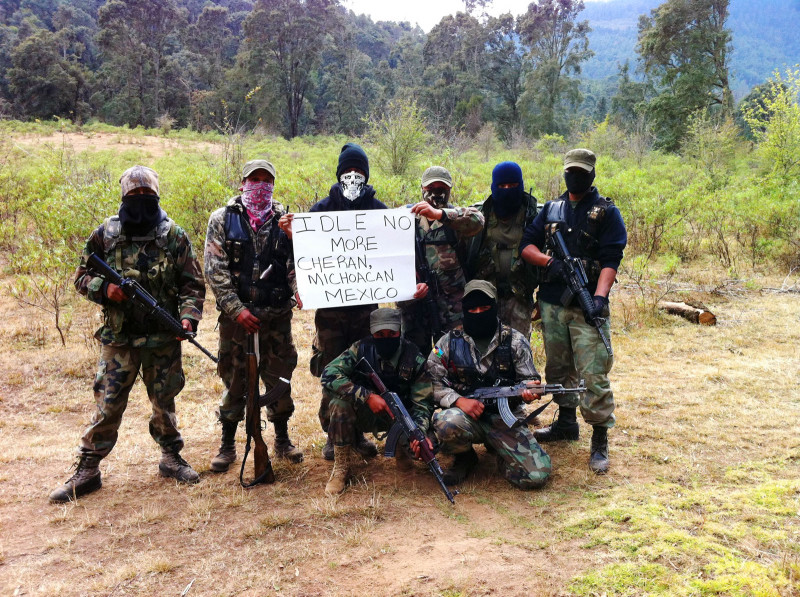
Idle No More Cheran
Forest defenders from Cheran, Michoacan are in solidarity with the Idle No More movement from Canada.
http://elenemigocomun.net/

http://elenemigocomun.net/
Saturday, January 5, 2013
“We Are Here”: Zapatistas Send Silent Message With the Return of the PRI
“We Are Here”: Zapatistas Send Silent Message With the Return of the PRI
30/12/2012 by Gloria Muñoz Ramírez
 Imagine
close to 50,000 people marching in absolute silence, in five different
townships, from two to five hours apart. Not a word, nor even a
greeting. Just a raised fist in a sign of strength, determination and
unity. Streets overflowing with masked faces and wordlessness. It is a
huge demonstration of force–the largest in the entire history of the
Zapatista movement–just days before the 19th anniversary of their first public appearance and 30 years since their founding.
Imagine
close to 50,000 people marching in absolute silence, in five different
townships, from two to five hours apart. Not a word, nor even a
greeting. Just a raised fist in a sign of strength, determination and
unity. Streets overflowing with masked faces and wordlessness. It is a
huge demonstration of force–the largest in the entire history of the
Zapatista movement–just days before the 19th anniversary of their first public appearance and 30 years since their founding.
What’s behind a mass mobilization like this, with no more resources than what the communities themselves can offer? Without the spending accounts of political parties or other organizations that only mobilize with government money?
The Zapatista Army of National Liberation (EZLN, by its Spanish initials) has taken a stance again. It wasn’t a surprise like the first dawn of 1994, since the Dec. 21, 2012 reappearance had been announced beforehand. But no one knew it would be in silence and with greater strength than two decades ago. Twenty years ago no one imagined the EZLN even existed and although the state had enough information to predict the attack, it preferred to wait to act to avoid dampening the parade of its entrance into the First World with NAFTA. Those days of January 1994, the government immediately ordered military operations, but it had already been surprised, along with the rest of the world. The same thing happened 19 years later, this time without arms.
With the federal army deployed throughout the territory with the pretext of the war on drugs, Chiapas is the most militarized state in the country. In a show of defiance, the Zapatistas retake the streets and the two flags that they have always flown—the EZLN flag and the Mexican flag—wave freely. They carried these two flags in 1994, they have walked with them throughout the years, they always bear them. They earned the right to traverse the country with their message of rebellion, with an army that backs them up, from the first twelve days of combat. No one can deny then that right.
Five presidents have ignored their demands. All have wanted to annihilate them, by bullets or with expensive government counterinsurgency programs. Slander and smear campaigns have surrounded them. The last year has seen a flurry of rumors of the death or illness of the spokesperson and military chief, subcomandante Marcos, who now has proved alive and well, like the tens of thousands of indigenous people of the organization who make up the backbone of the movement.
The silence of the march and the brief communiqué afterward revived expectations. What’s next? When? Not only those from below are asking, Enrique Peña Nieto must also be wondering, along with the many-colored and many-faceted powers that be, since it is clear that even though they avoid speaking their name and pretend that therefore they don’t exist, the demonstration of Dec. 21 is only the beginning. They’re there, and they’re legion. They are rebels. No one can buy them off. They are not divided. Their spokesperson is still their spokesperson. They are coming.
They surprised Carlos Salinas de Gortari in 1994, in the middle of his New Year dinner and what was not only the end of his administration, but also, and for the elite, the beginning of a new era–one that was not supposed to include an insurrection from below. A declaration of war and the military takeover of seven municipal seats by an indigenous army was Salinas’ send-off.
Ernesto Zedillo was greeted in office with the message: “Welcome to the nightmare”. This was followed by a position that has remain unchanged since then: “You should disappear, not only because you represent a historic relation, a historic aberration, a negation of humanity, and a cynical cruelty; you should disappear also because you represent an insult to the intelligence. You made us possible; you made us grow. We are your other, your Siamese opposite. To get rid of us, you must disappear.” The Zapatistas began the Zedillo administration with the Third Declaration of the Lacandon Jungle, in which they proposed the creation of a Movement for National Liberation.
 The
third presidency the Zapatistas experienced was headed by Vicente Fox
Quezada, of the National Action Party (PAN), who broke with more than 70
years of PRI hegemony. They told Fox from the first day of his
government: “There should be no doubt. We are your opponents.” With this
message one of the most important mobilizations of the Zapatista
movement began—the March the Color of the Earth.
The
third presidency the Zapatistas experienced was headed by Vicente Fox
Quezada, of the National Action Party (PAN), who broke with more than 70
years of PRI hegemony. They told Fox from the first day of his
government: “There should be no doubt. We are your opponents.” With this
message one of the most important mobilizations of the Zapatista
movement began—the March the Color of the Earth.
The re-election of the PAN to the federal government with Felipe Calderón Hinojosa at the helm was the next time the EZLN saw a change in government. This was also the launching of the Other Campaign, announced the first day of 2006: “We are going to begin to walk to keep our promise made in the Sixth Declaration of the Lacandon Jungle. I will be the first to come out,” said Subcomandante Marcos, “to see what the path we will be walking is like and if there are dangers, and to learn to recognize the face and the word of our fellow travelers. To unite the Zapatista struggle with the struggle of workers in the cities and countryside of our country called Mexico.”
Today, five administrations later–with the important construction of autonomy in their villages, after many encounters and dis-encounters, with more than a few pains–the first message to the return of the PRI, and especially and as always to the people, is absolutely clear: “We are here.”
Gloria Muñoz Ramírez is the director of Desinformémonos, www.desinformemonos.org, where this article was first published in Spanish and a contributor to the CIP Americas Program at www.cipamericas.org.
Translation: Laura Carlsen Photos: Tim Russo, Leonidas Oikonomakis
For More Information:
Series of articles on indigenous autonomy in the Zapatista communities of Chiapas, by Gloria Muñoz Ramírez.
Caracol #1: La Realidad, http://www.cipamericas.org/archives/1609
Caracol #2: Oventic, http://www.cipamericas.org/archives/1610
Caracol#3: La Garrucha, http://www.cipamericas.org/archives/1597
Caracol #4: Morelia, http://www.cipamericas.org/archives/1604
Caracol #5: Roberto Barrios, http://www.cipamericas.org/archives/1593
30/12/2012 by Gloria Muñoz Ramírez
 Imagine
close to 50,000 people marching in absolute silence, in five different
townships, from two to five hours apart. Not a word, nor even a
greeting. Just a raised fist in a sign of strength, determination and
unity. Streets overflowing with masked faces and wordlessness. It is a
huge demonstration of force–the largest in the entire history of the
Zapatista movement–just days before the 19th anniversary of their first public appearance and 30 years since their founding.
Imagine
close to 50,000 people marching in absolute silence, in five different
townships, from two to five hours apart. Not a word, nor even a
greeting. Just a raised fist in a sign of strength, determination and
unity. Streets overflowing with masked faces and wordlessness. It is a
huge demonstration of force–the largest in the entire history of the
Zapatista movement–just days before the 19th anniversary of their first public appearance and 30 years since their founding.What’s behind a mass mobilization like this, with no more resources than what the communities themselves can offer? Without the spending accounts of political parties or other organizations that only mobilize with government money?
The Zapatista Army of National Liberation (EZLN, by its Spanish initials) has taken a stance again. It wasn’t a surprise like the first dawn of 1994, since the Dec. 21, 2012 reappearance had been announced beforehand. But no one knew it would be in silence and with greater strength than two decades ago. Twenty years ago no one imagined the EZLN even existed and although the state had enough information to predict the attack, it preferred to wait to act to avoid dampening the parade of its entrance into the First World with NAFTA. Those days of January 1994, the government immediately ordered military operations, but it had already been surprised, along with the rest of the world. The same thing happened 19 years later, this time without arms.
With the federal army deployed throughout the territory with the pretext of the war on drugs, Chiapas is the most militarized state in the country. In a show of defiance, the Zapatistas retake the streets and the two flags that they have always flown—the EZLN flag and the Mexican flag—wave freely. They carried these two flags in 1994, they have walked with them throughout the years, they always bear them. They earned the right to traverse the country with their message of rebellion, with an army that backs them up, from the first twelve days of combat. No one can deny then that right.
Five presidents have ignored their demands. All have wanted to annihilate them, by bullets or with expensive government counterinsurgency programs. Slander and smear campaigns have surrounded them. The last year has seen a flurry of rumors of the death or illness of the spokesperson and military chief, subcomandante Marcos, who now has proved alive and well, like the tens of thousands of indigenous people of the organization who make up the backbone of the movement.
The silence of the march and the brief communiqué afterward revived expectations. What’s next? When? Not only those from below are asking, Enrique Peña Nieto must also be wondering, along with the many-colored and many-faceted powers that be, since it is clear that even though they avoid speaking their name and pretend that therefore they don’t exist, the demonstration of Dec. 21 is only the beginning. They’re there, and they’re legion. They are rebels. No one can buy them off. They are not divided. Their spokesperson is still their spokesperson. They are coming.
They surprised Carlos Salinas de Gortari in 1994, in the middle of his New Year dinner and what was not only the end of his administration, but also, and for the elite, the beginning of a new era–one that was not supposed to include an insurrection from below. A declaration of war and the military takeover of seven municipal seats by an indigenous army was Salinas’ send-off.
Ernesto Zedillo was greeted in office with the message: “Welcome to the nightmare”. This was followed by a position that has remain unchanged since then: “You should disappear, not only because you represent a historic relation, a historic aberration, a negation of humanity, and a cynical cruelty; you should disappear also because you represent an insult to the intelligence. You made us possible; you made us grow. We are your other, your Siamese opposite. To get rid of us, you must disappear.” The Zapatistas began the Zedillo administration with the Third Declaration of the Lacandon Jungle, in which they proposed the creation of a Movement for National Liberation.
 The
third presidency the Zapatistas experienced was headed by Vicente Fox
Quezada, of the National Action Party (PAN), who broke with more than 70
years of PRI hegemony. They told Fox from the first day of his
government: “There should be no doubt. We are your opponents.” With this
message one of the most important mobilizations of the Zapatista
movement began—the March the Color of the Earth.
The
third presidency the Zapatistas experienced was headed by Vicente Fox
Quezada, of the National Action Party (PAN), who broke with more than 70
years of PRI hegemony. They told Fox from the first day of his
government: “There should be no doubt. We are your opponents.” With this
message one of the most important mobilizations of the Zapatista
movement began—the March the Color of the Earth.The re-election of the PAN to the federal government with Felipe Calderón Hinojosa at the helm was the next time the EZLN saw a change in government. This was also the launching of the Other Campaign, announced the first day of 2006: “We are going to begin to walk to keep our promise made in the Sixth Declaration of the Lacandon Jungle. I will be the first to come out,” said Subcomandante Marcos, “to see what the path we will be walking is like and if there are dangers, and to learn to recognize the face and the word of our fellow travelers. To unite the Zapatista struggle with the struggle of workers in the cities and countryside of our country called Mexico.”
Today, five administrations later–with the important construction of autonomy in their villages, after many encounters and dis-encounters, with more than a few pains–the first message to the return of the PRI, and especially and as always to the people, is absolutely clear: “We are here.”
Gloria Muñoz Ramírez is the director of Desinformémonos, www.desinformemonos.org, where this article was first published in Spanish and a contributor to the CIP Americas Program at www.cipamericas.org.
Translation: Laura Carlsen Photos: Tim Russo, Leonidas Oikonomakis
For More Information:
Series of articles on indigenous autonomy in the Zapatista communities of Chiapas, by Gloria Muñoz Ramírez.
Caracol #1: La Realidad, http://www.cipamericas.org/archives/1609
Caracol #2: Oventic, http://www.cipamericas.org/archives/1610
Caracol#3: La Garrucha, http://www.cipamericas.org/archives/1597
Caracol #4: Morelia, http://www.cipamericas.org/archives/1604
Caracol #5: Roberto Barrios, http://www.cipamericas.org/archives/1593
Thursday, January 3, 2013
Thursday, November 29, 2012
Sunday, November 25, 2012
Subscribe to:
Posts (Atom)